
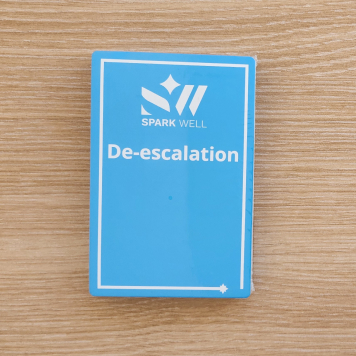
De-escalation Cards
De-escalation Cards
De-escalation can help students build de-escalation techniques through active listening and understanding.
You should have 50 de-escalation cards in your de-escalation card’s pack.
De-escalation Cards
Here are 10 de-escalation card games that you can play with individual students or across your entire classroom to build some great de-escalation habits. As there are 50 cards in your de-escalation card pack, you can make many more games!
Be creative, have fun and enjoy learning!
Lucky Dip
Charades
Match the Moment
Calm Corner Builder
Two Truths and a Calm
Challenge Relay
What Would You Choose?
Card Skits
Teach the Teacher
Confidence Countdown
Lucky dip 2.0
Face up
Goal Getter
Choose your vibe
Story Spark
Story Spark Chain
Story Spark Swap
What Went Well
Pick your thanks
Design the deck
Growing Edge
The Mirror Game
Skill Swap
Strength or Skill BINGO
Build the Team
Spark Card Fusion
Spark Quest
The Mentorium
Spark Story Builder
Spark Circle Walk
Lucky Dip
Students sit in a circle. One student picks a random card from the deck and reads it aloud.
Challenge:
The whole class must act it out for 20 seconds (e.g. take a deep breath, trace a square, count backwards).
Why it works:
Builds familiarity and makes strategies feel normal and non-threatening.
Charades
A student draws a card but cannot speak. They act out the strategy, and the class guesses which one it is.
Fun factor:
Kids get creative and the class stays engaged.
Match the Moment
Give students scenario cards (e.g. I lost my pencil, Someone pushed in, I feel overwhelmed with work).
Students choose a de-escalation card that best fits the scenario and explain why.
Extension:
Debate which strategy is most effective and why.
Calm Corner Builder
In groups, students pick 3–5 cards and design a Calm Corner poster using only those strategies.
Outcome:
A classroom display students use because they co-created it.
Two Truths and a Calm
Students share two strategies that help them and one they’ve never tried (or don’t think will help).
Others guess which one is the calm (the unfamiliar one).
Great for:
Discussions about preference and choice.
Challenge Relay
Set up 3 stations, each with a handful of cards.
Teams rotate through the stations completing the strategy on the top card.
Goal:
Work together and stay calm while moving.
Would You Choose…?
Students pull two de-escalation cards and choose the one they’d use if they were feeling:
– frustrated
– worried
– angry
– overstimulated
Quick way to talk about tailored strategies.
Card Skits
In small groups, students draw one card and create a 15–30 second skit showing a problem + how the strategy helps.
Perform for the class.
Tip:
Works brilliantly for upper primary and secondary.
Teach the Teacher
A student pulls a card and becomes the teacher.
They guide the class through the strategy as if they’re running a mini-lesson.
Perfect for boosting confidence and modelling.
Confidence Countdown
Pick one de-escalation card and set a 30–60 second timer.
Students try the strategy silently until the timer ends.
Use anytime:
Transitions, after breaks, or before assessments.
Lucky dip 2.0
Cards are placed face down. Students choose a card and can either:
– Name an example of a time they have used that skill or strength.
– Name someone else who displays the strength or skill
– Suggest a way they could practice that strength or skill
Describe what it would look like and or sound and feel like to observe someone else, or be using that strength or skill themselves.
Anything else that you or your colleagues and students can think of when picking up.
Face up
Goal Getter
Students choose a card that is a strength or skill you’d like to work on. You may want to keep it, or a picture of it handy as a visual reminder.
Choose your vibe
Students choose a card they use to describe the way they feel or would like to feel and keep it close by for the day. At the end of the day or lesson, reflect on how it went.
Story Spark
Story Spark Chain
Students all get a card. Someone then starts a story with a sentence relating to that skill/strength. The next person builds on the story with their chosen card and so on.
Story Spark Swap
Each player draws one card at random and tells a story as if that were their superpower. They could be funny or sincere, real or fantasy depending on context and your crowd.
What Went Well
You or your student/s choose a card at the start of the day and keep on display. At the end of the day, every student thinks of a way they have used that skill or strength throughout the day. Alternatively, they could also say how they saw someone else using that skill, making sure everyone hears their name to ensure fairness.
Pick your thanks
Design the deck
A game where players create their own version of a card, by drawing, writing, or collaging something personal, symbolic, or creative. This could be their favourite card, or to introduce critiquing, students can choose a card they believe they can improve, giving reasons why, and designing their new and improved version.
Growing Edge
The Mirror Game
A student may stand up, perhaps tell a story or share something that they have done, or a challenge they have faced. Other students pick cards they see as strengths in them. Great for confidence building and practicing active listening.
Skill Swap
Students pick one strength they have and one they’d like to learn. Students then partner up with someone whose “have” matches the other persons “learn.” Students then share how they could support each other.
Strength or Skill BINGO
Each player gets a bingo sheet with different strengths listed. As they spot strengths in others during a discussion or activity, they mark them off.
Build the Team
Lay out a scenario (e.g. starting a project or surviving on Mars). Everyone selects cards representing the strengths/skills they’d bring to the team. Discuss how they fit together.
Spark Card Fusion
Students pick two random cards and imagine a new profession, invention, or character that combines them. For example, empathy + organised = Emotional Architect.
Spark Quest
Assign each player a “mission” (such as solve a current problem, a hack-a-thon) and have them pick 3 cards that represent the strengths/skills to complete it.
For example:
“You must rebuild a lost city using the strengths of adventurous, resourceful and fair — go!”
The Mentorium
This activity is designed to encourage peer learning and recognition. Everyone picks a card they’re strong in and offers to mentor that skill to another player for the day/week.
Spark Story Builder
Draw 3 cards, lay them out. Players create a short story that includes all three cards.
They can use the cards as character strengths, or as a skill the character needs to solve a problem.
Spark Circle Walk
Spread cards in a big circle on the floor. Players walk around until music stops. Players pick up the closest card, and can say something about how that card relates to them.